Hitting a major anniversary is always cause to look back and reflect on how far you’ve come. That’s certainly the case this year for us at Seafood New Zealand – and the fishing industry overall – as we acknowledge the significant 40-year milestone of our Quota Management System (QMS) and the way it has allowed us to sustainably manage our fisheries for decades. The ongoing existence of the QMS is one major reason why our fisheries management system is considered to be one of the best in the world (according to a United Nations ranking), and why such a high percentage of our stocks continue to be scientifically evaluated as being in good shape. These are proof points we as a country can be rightly proud of.
But looking back 40 years – to 1986! – also affords us an opportunity to see how things have changed.
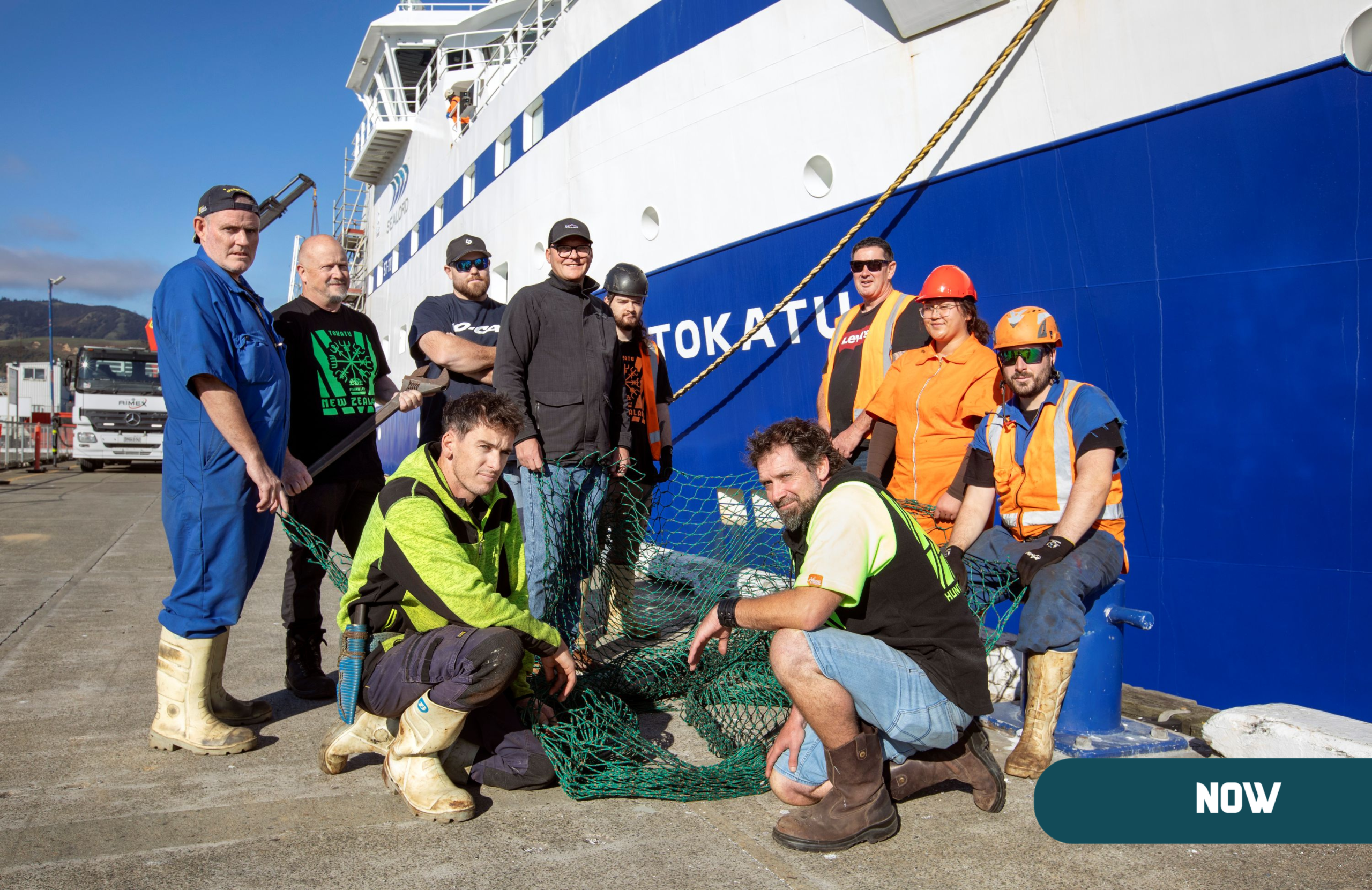
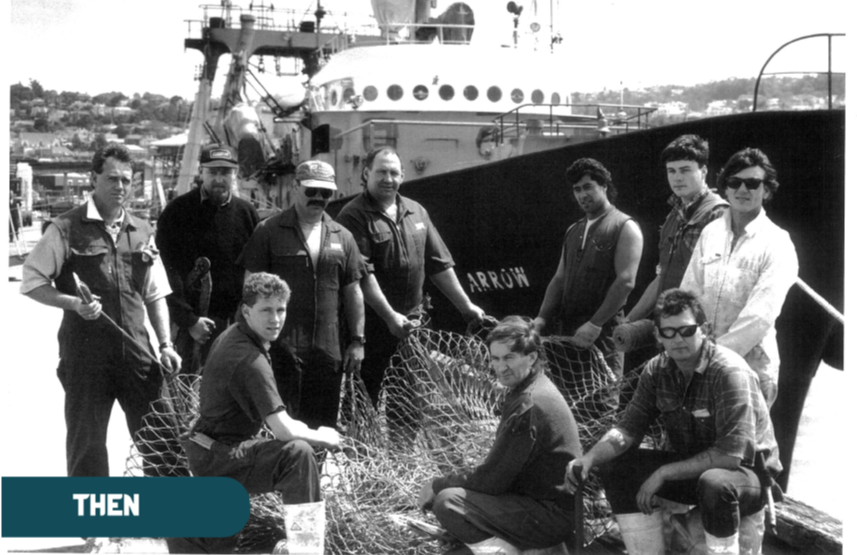
Above left: The vessel crew from Sealord’s FV Arrow at the Nelson wharf in 1983. Above right: Vessel crew from the Tokatu, the largest deepwater fishing vessel in New Zealand, recreating the pic in 2026. Courtesy of Sealord.
And we’re not just talking about the vibe changes. When we think about ‘the 1980s’ quite a bit immediately comes to mind – the iconic power shoulder and matching suit set. Big hair and big moustaches. Jazzercise. The Brat Pack. The Police, Guns ‘N Roses and Blondie. The ‘home computer’ was still a fledgling concept. In 1986, Compaq had just released the Deskpro 386 which introduced 32-bit microprocessors and had (for then) a whopping 4 kilobytes of memory. That’s 0.000000001 Terabytes, nearly unthinkable today.
This is the framework stock management, scientific research and fishing was taking place in. Catch reporting was manual, with fishers recording on pen and paper. Scientific stock assessment models evolved with the data researchers were able to collect – as did knowledge about different species.
Today we have so much more at our fingertips. Reporting has gone digital, with our on-board camera programme electronically monitoring 85% of our inshore finfish catch. Huge advances in AI have transformed data processing. Earth Sciences NZ (formerly NIWA) continues to be at the forefront of essential fisheries research, utilising new technology like the SwathCam and state-of-the-art research vessels, like the Kaharoa II.
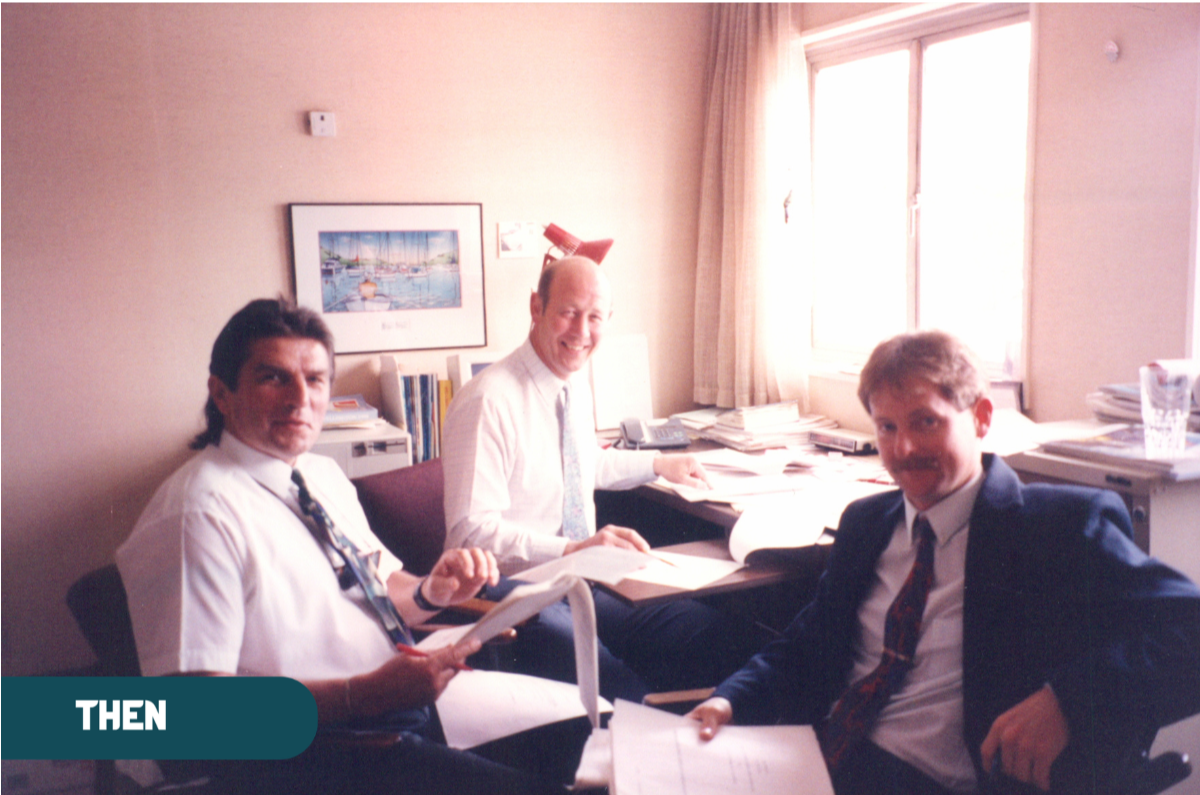
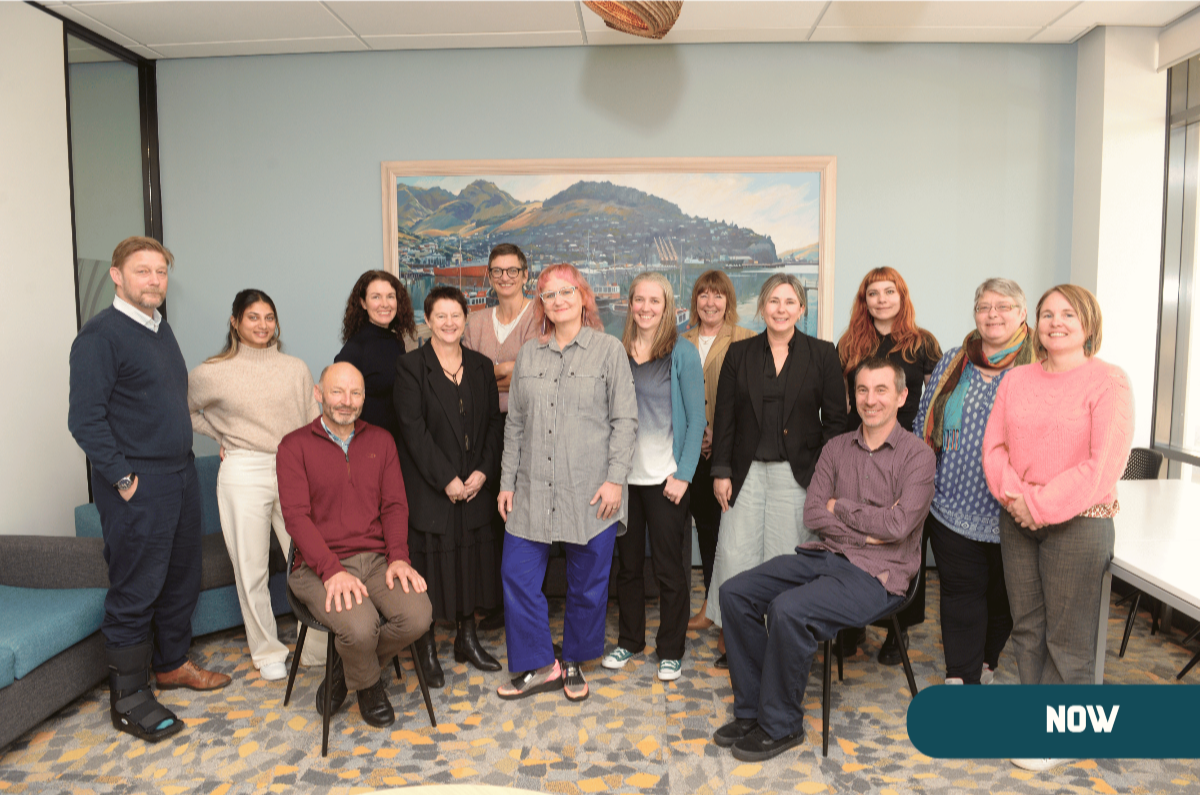
Above left: Daryl Sykes, Andrew Branson and Mark Edwards. Above right: The Seafood NZ team today. Courtesy of Seafood NZ.
But though there has been a lot of change – the fundamentals have never altered.
Those fundamentals are our commitment to sustainability, to transparency, and to caring for the health of the moana that we all rely on. The tech may have changed, but our values haven’t. We hope the fisheries management reforms currently under consideration can be brought into this ‘now’ as well, so we can take advantage of the information and technology now available to us…we aren’t working in 4 kilobytes anymore, after all!
This is our ‘now,’ and we will be celebrating these 40 years of progress at our conference next week. We hope to see many of you there.
In the leadup, we’re dipping into the archives and sharing a selection of ‘then and now’ snaps from fishing companies, Earth Sciences NZ, our fishers and Seafood NZ. You’ll spot more than a few familiar faces (and some great hairstyles).
More about how we are ‘Realising the Vision’ at our 2026 conference